Biggest-ever Roman wall mosaic, featuring mysterious port city, revealed
Near the Colosseum, another vision of ancient urban life is coming into focus: a port city preserved in an enormous Roman wall mosaic. Its buildings, waterfront, and figures offer remarkable detail, yet archaeologists still cannot answer its most intriguing question. Was this a real destination, or a place imagined by its creators?
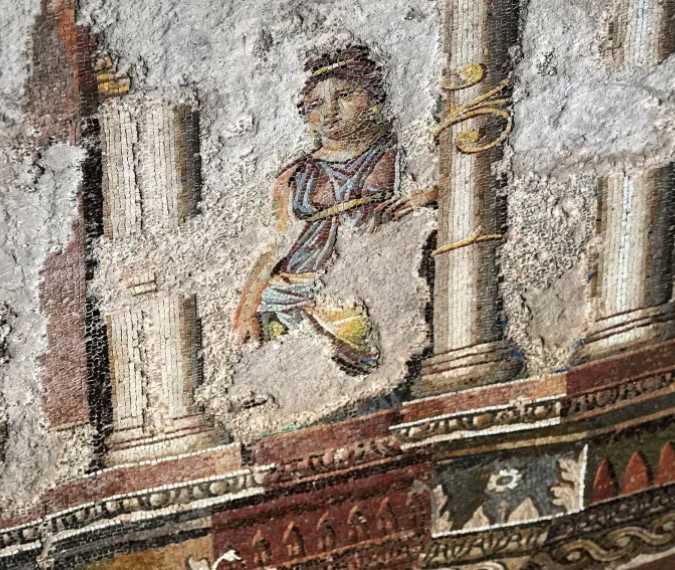
Known as the Great Mosaic, the artwork lies beneath Rome’s Oppian Hill. Measuring about 10 meters high and 16 meters long, the archaeological team has described it as potentially the largest Roman wall mosaic ever discovered. Its full extent remains uncertain as excavation continues.
The mosaic and a nearby fresco were unveiled after a 14-year restoration project, revealing another layer of history in an area associated with both Nero’s palace and Trajan’s public baths.
A City That Has Yet to Be Identified
The mosaic presents a bird’s-eye view of a fortified harbor city, with towers, public spaces and scenes of activity. Although its blue and terracotta tones have faded, surviving details convey the ambition of the original design.
Above the cityscape, human figures appear to observe the scene below. They include a bearded philosopher, a figure described as his muse, and a young poet. Architectural and theatrical elements, including columns and garlands, add to the elaborate composition.
Marble and gemstones helped create shimmering effects intended to evoke sunlight on water. The result brings together an urban panorama and the visual drama of a stage performance.
Some architectural features are unusual for the first century AD, when the mosaic was made. Researchers have not identified a known city matching the scene, leaving open the possibility that it depicts an idealized harbor rather than a specific place.
From Imperial Surroundings to Public Baths
The artwork’s original setting is another unresolved part of its story. Nero built his celebrated Golden House in this area between AD 64 and 68. Still, archaeologists have not established whether the mosaic belonged to that complex or to a separate residence later absorbed into it.
The neighborhood changed again under Emperor Trajan, who built his baths here in AD 109. The earlier decorations survived within the area transformed by this vast public development.
A Second View of Ancient Life
Nearby, a fresco called the “Painted City” offers another detailed urban scene. Discovered during excavations in the 1990s, like the mosaic, it dates to the first century AD and covers roughly 10 square meters.
Its painted architecture includes a harbor gateway, roads, a theatre and a temple within a walled settlement. Together, the two artworks give researchers valuable material for studying how ancient artists represented cities.
The work is still unfolding. Archaeologists are also exposing a section of mosaic depicting grape harvesting and wine production.
For travelers interested in Rome’s layers of history, these discoveries draw attention to the Oppian Hill beyond its imperial associations. Installed walkways and lighting help reveal the surviving decoration, while the unidentified harbor remains a reminder that even a richly detailed picture of antiquity can keep its secrets.